Disciples

Showing posts with label Arab World. Show all posts

Saturday, 19 November 2011

The Movement


Peurta del Sol, Madrid, Spain, April 2011 during the "Spanish Revolution"
           
               As now night falls upon Zuccotti park in New York City, as the lights of the grand boulevards illuminate the skyline, as planes, like flashing stars dash through the Manhattan sky, one man looks down. That man a normal man probably in his 50's, a typical, banal man, of which we do not much looks down. And as the plane starts its decent into the New York City airspace, he senses somehow, somewhere, something in this city, this huge megalopolis of millions and millions of inhabitants, the cosmopolitan "neo-babylonia" has changed. And who could deny him that though? Who could tell him that his perception was wrong?
Mr X flying lonesomely on that Boeing 747 overflying the labyrinth of lights that is NYC, sensed something that we've known for a bit over 2 months, something that the whole world has felt deep down in its "general" gut, the "general" gut feeling that Zuccotti park, alike Peurta del Sol in Madrid, or Tahir Square in Cairo is one of those front-lines, in the tricky war to redefine what democracy and justice is in the 21st century.
For years now, we've heard about fault-lines, fault-lines that were drawn throughout this world, drawn in the tears, the pain and the blood of millions of working families, throughout the world. Detroit and New Orleans the American fault-lines of this universal crisis created by some, but paid by the many. The burning streets of Athens, the open veins of Latin American, and carbonized cars of Seine Saint-Denis are also the fault-lines of this massive counterrevolution.
Occupy Anchorage, Alaska, U.S.A. 2011

A counterrevolution, for revolution in its primary sense, and it's rightful meaning is rotation of things until they realign into their rightful order, basically the way things should be.
And this is were history, and "The Movement" enters the scenery. Maybe it's a very plain, simple line of thought but after an analysis of modern history, two key movements seem to push forward.
Let's stroll back through history lane, to find the source of this amazing movement of "civil rights/ democratization". Probably some would say that this movement of perpetual change progression (revolution), that like a drop of water in an almost full cup, that drop by drop tries overflow, started a while back way before my "starting" date, but in this case I underline 5 particular popular movements in modern history that founded the basis for our actual society: The Reformation (Peasants Wars), The Liberal Revolutions (The American and French Revolutions), The Marxist Revolutions and finally later on in the 20th century, the Fights for National Liberation in the 3rd world, and the Civil Rights Movement were drops that tried to push the balance of universal justice more and more to it's righteous position.
At the same time for each step forward, their was the possibility if an error was committed to take three steps backwards. For inter-tangled in the common massive and impressive human "general" psychology, are two sides, one side progressive that embraces revolution and the other side regressive or conservative that in the face of revolution enhances counterrevolution. Of course in detail this is far form being true, their are zones of grey that are more important, then the clearly defined zones of white or black. Even so, general trends do exist and do help us understand the "general" maybe even very general direction of our human enterprise.
Moscow, Russia December 2011

As I've said earlier we now live in a world that is cut-up and devised through lines. Fault-lines and front-lines. We live in a world of gates and gate keepers, of those that have and those that have not or nothing. And the history of the world has always been this way, for some it will always be this way, it's as some say part of human nature. But I beg to differ, I think that from time to time the general subjugated conscience of those "have-nots" does get to a boiling point, and at that specific moment when those that the established power has underestimate, revolt and push for change, it's at that specific moment that the "movement" is born.
Back in the 1960's a similar movement was born. At the end of the 1960's the movement that eventually broke-up into very divergent "sub-movements" (from the Black-Panther Party for Self-Defence and the Weather Underground Organization to the non-violent Hippie movement) it started far away from the urban centres of Chicago or New York, it started in the deep south (in Alabama). Alike the "general" civil disobedience movement in the 1960's this movement of revolt was born in the most improbable and in a what can be considered the periphery. It started in Tunisia about a year ago and spread throughout the world at an amazing speed rate. The links between all of this movement, tend to draw a general trend, of this bigger then life "movement". For example Reformation ignited Europe like a wild fire, creating more 100 years of Political instability, and the Reformation was started by the most odd of acts and surely Martin Luther himself predicted little, if not anything of how the pinning-up of his statement would change forever the world as he knew it. Little did the leaders of the Boston Tea Party know that their acts would inspire a new revolutionary era.
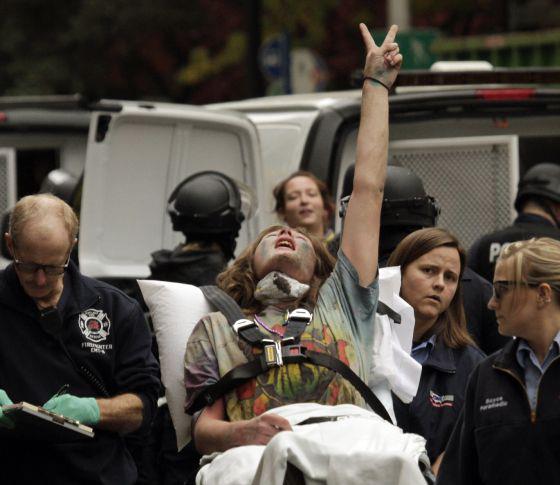
Occupy Portland, November 2011

But from my point of view it seems as if this movement that was supposed to continue in a sort of Hegelian manner it's "progress" stalled along the way.
For I believe that we are at a very critical turning point in the history of humanity. The values that were born in the aftermath of the Reformation (a specific set of values, not the entirety of the values that came out of the religious and theological upheaval that was the Reformation), the same values as the thesis of Max Weber has proven we're the basis of modern Capitalism and of our modern Liberal democracies are exhausted.
Curitba, Brazil 2011

I think that we are at a time alike the realignment of the world, after the birth of "modern" religions such as the birth of Christianity.In history there have been major shifts that have redefined how us "inhabitants" vision our place in our common environment. I believe that one of the major shifts in our world was the "building-up" of modern Capitalism as we know it. I also have for firm believe that the installation of this Capitalistic system created the long and brutal 20th century (in this logic WWI and WWII were in some sort reactions to this construction of Capitalism). And I believe that what we are witnessing today, what we are participating in today is anew realignment of the world.
Looking back to the 1960's, the general civil disobedience movement, was the basis for a real realignment in the way we apprehend our world, in the way we interact inside our own environment and also how we conceive the world that surrounds us. It was overall a revolt, but beyond that it was redefinition of our common sense, by common sense I mean the social fabric that brings us together and out of which we can create bonds, in the end common sense is the foundation of the world-systeme we live in.
The Christian revolution of values or the monotheistic revolution fundamentally changed the social fabric/ "common sense" of the ancient world and built the basis of the modern world. But little by little this monotheistic foundation of our "modernity" was chipped away by the new realignment that had for philosophical source the enlightenment. The enlightenment built the basis for the liberal philosophy. The first big revolution that started to "pull the rug" underneath the feet of the monotheistic (in the occident) was the Reformation it built the theological bedrock for protest, and at the time to contest the authority of the church of Rome was to contest the major legitimate power of the time. After the liberal revolutions that started in England in 1688 and the liberal revolutions that fallowed in 1774 and 1789 set the battlefield for the 19th century, between the slipping power of religion and the new liberal influence.
During the 20th century the political theory known to us as Liberalism clearly implanted itself, through what we could call the institutionalization of democracy, something that seems at times paradoxical. By affirming such a thing I affirm the fact that democracy is fundamentally very little "institutionalized" and our current "crisis of democracy" has for direct origin this fundamental paradox that lies in the construction of representative "liberal" democracy (our modern form of democracy).
Damascus, Syria "The Arab Spring" April 2011

And we are at this point in time, in this space and dimension, and things oddly seem to be shifting. Things in general (the common history of mankind) and things in particular (each and everyone's singular experience) tend to at some times function in the same manner. It's when you least expect it, in places less probable and of improbable people that fundamental change outbursts. And that is probably what is so great about life in general, it's improbable side to it. Looking back on 2011 who, would of expected all of these occurrences, we try to plan things its part of human nature, we tend to find confront in planing the future and building on that... of course no one can build on the improbable, but we must rejoice of this improbability and this unknown and unmapped face of our lives and our common future in this human society.
Cairo, Egypt 2011
                           
As now the evening lights give into the dark nightfall skies, as the smoke lifts in Tahrir square in Cairo as the army now burns down to the ground the marks of any physical resistance. As the cold night swifts into Zuccotti square through the grand corridors of New York City's avenues and once again the occupiers face the dreadful night. As another Athenian family turns off the lights in the once cradle of democracy, now riddled with debt. As so many in this time of discontent and full of incertitude. Let us remember and recollect, that the movement still on goes, and still thrives and that this is just the beginning and what a start it is. The road ahead is long and steep, narrow and screechy, but we now know that the road out of here does exist. And everything depends on our capability to "occupy" our hopes and dreams, our expectation and beliefs, all depends on our efforts to reinstate our moral paramount over our fears and grievances, our restraint and disbeliefs.  That's the big personal and general fight of humanity, revolution or counterrevolution, for change is possible, but are we ready to "occupy" that change? I personally think that we are.
Sky.
Tahrir Square on Fire, December 2011.

Tuesday, 24 May 2011

Neo-Liberalism and the demise of Democracy. (Part One)


1978,1979 and 1980. These years will forever be recorded as a turning point in world history, even more profoundly in human societies and in our perception of democracy. These three dates are linked without any doubt with the "defacto" leading, world dominant ideology, that we call Neoliberalism. In 1978 around 1 year and a half after the death of the grand leader Mao Zedong, a new elite of reformers took power in Beijing. At their head a man called Deng Xiaoping, a man that had always been at odds with the economic ideal of Maoism. His repugnance of the ideal of an industrial superpower that for basis an agrarian society originated with his deception of the "Great Leap Forward" for him this great leap was more so a great leap backwards. And so after the death of ideological father of the Chinese revolution, the revolution would be betrayed by one of it's own. Deng Xiaoping started the great economic reforms that would lead to the installation of a "capitalistic statism", in practice it meant the opening of certain sectors of the economy to private capital, and private enterprise in the so-called Special Economic Zones (SEZs) this was the first step towards the global economic power that China beholds today. But Xiaoping economic reforms did not change much in political or social terms, the fact is that the Xiaoping reforms were the birth of the Neoliberal tendency in China and the real implementation of Neoliberal policies in one country or was it?
In 1979, the United States under Jimmy Carter was on the brink of oblivion, at least that's the perception that the American public had of the denouement of the then being current world affairs. First of all Communism seemed on the rise throughout the world specially in Africa with the newly independent states of Angola and Mozambique. The Soviet army was on the offensive in Afghanistan and the debacle of Vietnam wasn't so far away form American minds. In economic terms the stagnation crisis had undermined the capitalistic model and so in a rush to save American two men would appear. First of that had for objective to save the economy, his name was Paul Volcker he become the boss of the Fed in 1979 with a mandate to curb the power of the almighty American trade unions and to make the inflationary and stagnation crisis history. In 1980 Reagan would join his side after being elected president of the United States of America on a platform of "American Renaissance". In Europe the "Iron Lady" Margaret Thatcher was elected on basically the same agenda. And so the birth of the "new brave world" occurred, little did they know back then that this Neoliberal revolution would forever change the face of the globe. The question that must be asked at some point is the fallowing, certainly the Neoliberal doctrine did help the United States gain hegemony and overthrow the decadent Soviet Union but at what cost? How could a doctrine that was said to be "umbilically" linked with freedom and liberty instate so many dictatorships? Today as the liberalization of the world continues little by little and more and more so, so does the demise of Democracy.

The Chilean prophecy. 
Salvador Allende

The ideological birth of Neoliberalism can be traced back in time to the 1930's and even before, but the object of study here is not Neoliberalism as an idea, instead Neoliberalism as a political actor, and the Neoliberal political actor first took stage on the 11th of September 1973 in the Southern American country of Chili. Neoliberalism first became a political arm during the period form Salvador Allende's election in 1970 to the 11th of September of 1973 the date of the Pinochet coup that would be the start of long bloody, horrid, black page of global history. Salvador Allende a figure very much forgotten in these days and times, was the ancestor of the actual left-winged leaders of Latin America. Salvador Allende implemented what he called the Chilean path to socialism lifting a very important percentage of Chileans out of extreme poverty, through social reforms, nationalizations and public works, his administration reduced unemployment and inequality in the country and prepped-up Chili's heath care and public education, But his most controversial policy was the decision to size land form the rich landowning families that were until Allende's ascension the holders of all the economic and so for political power of the nation. After this decision a multiplication of strikes and the mounting fear of  American in losing their hegemony in the region (the birth of another Cuba) would final terminate Allende's regime through a CIA mounted coup that would bring a military junta to power under the effigy of Augusto Pinochet. 
Augusto Pinochet
 With the arrival of the Junta the Chicago-boys and the American hegemony had the opportunity under this puppet regime to modify the socio-economic structure of Chili to it's guise. As Naomi Klein explains in her masterpiece The Shock Doctrine, through the shock of military oppression Pinochet's junta would liberalize completely the entire Chilean society.  So through the economic policy implanted in Chili by the economic reform plan called the brick. Chili's economic growth would soar, the only problem was that this "economic miracle" (expression used by Milton Friedman) happened in one of the worst dictatorships in world and even probably in world history. The question that immediately comes to one's mind is, how could an ideology that professed that great liberalization economic would automatically engender greater political freedom accept it's practice under a dictatorship?  And how about if Neoliberalism was not indistinguishable form democratic freedoms but instead to the commonly "vehiculated" idea, how about if Neoliberalism need as a basis for it's expanse a dictatorial/corporatist state?

Operation Condor and the accession of Neoliberalism in Latin America.

As in Chili's case Neoliberalism just could make itself a space in the political spectrum, parties that employed their platform of rapid economic liberalization were very unpopular among the peoples of the Latin American states, so Neoliberalism had to overpass the democratic institutions to really take root, and that's where Operation Condor comes into action.
Operation Condor, was the sort of war on terror of the time. It was an operation that had for objective to join all the intelligence services ( more secret policies) of the Latin American dictatorships. The Operation Condor was probably one the most brutal political repression campaigns in modern history. It spanned throughout an entire continent. Under it's banner it encompassed various anti-subversive "tactics" (all of them out of the fascist playbook) such as the "Dirty War" in Argentina, the political repression in Brazil and the death camps under Pinochet in Chili. But then again there is shocking correlation to make between these forms of political repression and the implementation by these authoritarian governments of Neoliberal policies. Under the banner of "containing communism" the United States aided extremist right-wing military groups to gain power and to maintain it through techniques of repression exported through the canals of the School of the Americas, and what was asked in exchange economic liberalization, so that Latin America would be transformed into "economic satellites" of the great American industrial machine. But as was seen in Chili before and throughout Latin America after the Neoliberal economic policies were not accepted by the population, because Neoliberalism wasn't "democratic". Neoliberalism could not withstand "democratization" the first necessary element to instill Neoliberal policies is "dictatorial playgrounds". On that basis the Neoliberal economic policy killed democracy in Latin America for almost two decades, but after the Latin American "triumph" the dark mantle of Neoliberalism would spread through the world and transform itself to adapt in hostile climates.

Gaz, Oil and the "liberalization" of Iran and the Arab world.           
British Petroleum or Anglo-Persian Oil Company
The tale starts back in 1951, a predominant nationalist with socialist penchants is appointed prime minister in Iran. Dr. Mosaddegh then undertakes the important reform of nationalizing the very profitable Iranian petrol industry, that at the time being was in the hands of the Anglo-Persian Oil Company (the Iranian BP affiliate of the time), in other words an important pillar of the British economy. For Mosaddegh the plan was very plain and simple, with the revenue generated by the new nationalized petroleum industry he would soar his fellow countrymen out of the grips of poverty. But for the British the lose of such an important economic asset was mere folly and for the C.I.A. and the American government of the newly elected Eisenhower Dr, Mosaddegh socialist principals were flirting with communism in a way that made the United States uneasy. The only option now was a tactic that would become very well know in the future "Regime Change". So the tale of Dr. Mosaddegh and of his "nationalistic" adventure comes to an abrupt end in 1953. With unconditional tactic/strategic aide of the American and British secret services the conservative wing of the army mounted a coup and put on the thrown a new Shah.             
Another turning point in the "liberalization" of the middle east was the ascension of Anwar Sadat to the title of Rais in 1970. After Gamal Nasser's death in 1970, Anwar Sadat a high ranking military general as was Nasser took control of Egypt. First he was view as merely a puppet of the "Nasserist" elite, but through the "Corrective Revolution" Sadat eliminated the entire "Nasserist" vision form the circles of power. He then pursued the economic policy of "liberalization" something that was completely contradictory with Nasser's vision of "Egypt's self-determination".
And then came the period of the 1990's and the arrival of military junta's to power in all of the middle east implementing Neoliberal agenda's, as in Algeria that completely "liberalized" it's gaz and oil industry, the same in Tunisia, the "Tunisian Miracle" under the rule of Ben Ali, and in Libya with reconstruction of diplomatic relationships with country. Throughout the Arab world form Saudi Arabia to the United Arab Emirates, from Bahrain to Yemen, the United States through the C.I.A. and the so-called war against "the evil empire" that represented communism financed authoritarian regimes/ petro-kings and in return the only thing they asked for was the implementation of Neoliberal policies and the "liberalization" of their economies so that American enterprises could operate in total freedom. But what did this lead to? What did this mean for democracy? 
Without any doubt the direct consequences of the Neoliberal policies instilled by the various "puppet" regimes of the United States was grand popular discontentment, in lead to "Bread-Riots" in Egypt, a civil war in Yemen between "Socialist" and autocratic fractions, but the major shift it lead to without any doubt was the Islamic Revolution of 1979. It was a new kind of revolution, a one that did not lean to the west or to the east but stood on it's feet (at least at the beginning, afterwards it turned into one of the most repressive regimes in the world) and fought violently against the Neoliberal policies that were implemented by the Shah and his regime. It was more anti-capitalistic, then anti-occidental or anti-American, and detested the "western" main mise on the Iranian economy, it was the first anti-Neoliberal revolution. And it "breeded" a new sort of protestation Islamic radical terrorism. So we have seen how in the "3rd world" Neoliberalism destabilized and destroyed the democratic process, how it cut the grassroots of democratic aspirations, doing so under the theory that greater economic liberty would defacto engender greater political liberty a more democratic form of governance. But could Neoliberalism infiltrate western democracies and turn them into "facade democracies"? into D.O.I.N.'s (Democracies Only In Name)? Create the same oligarchic regimes that existed in the third world but dressed with the robes of democracy?

Sky